

Lagoon Amusement Park Terrazzo Project by FW Specialties Wins NTMA Honor Award
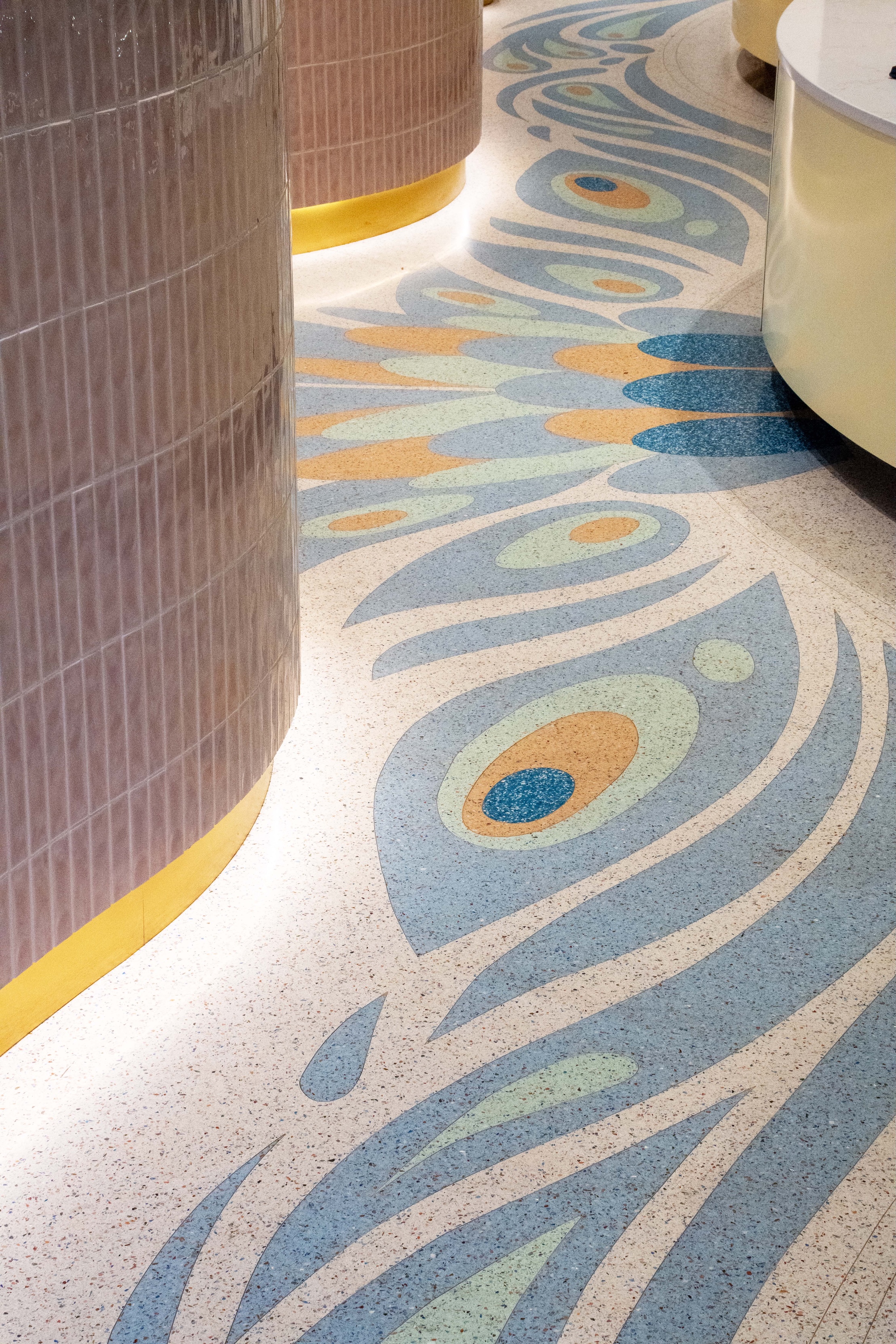
Lagoon Amusement Park’s Peacock Parlor features a handcrafted terrazzo floor whose sweeping peacock plume earned FW Specialties a 2026 Honor Award from the National Terrazzo & Mosaic Association. © Zach Stettler Photography
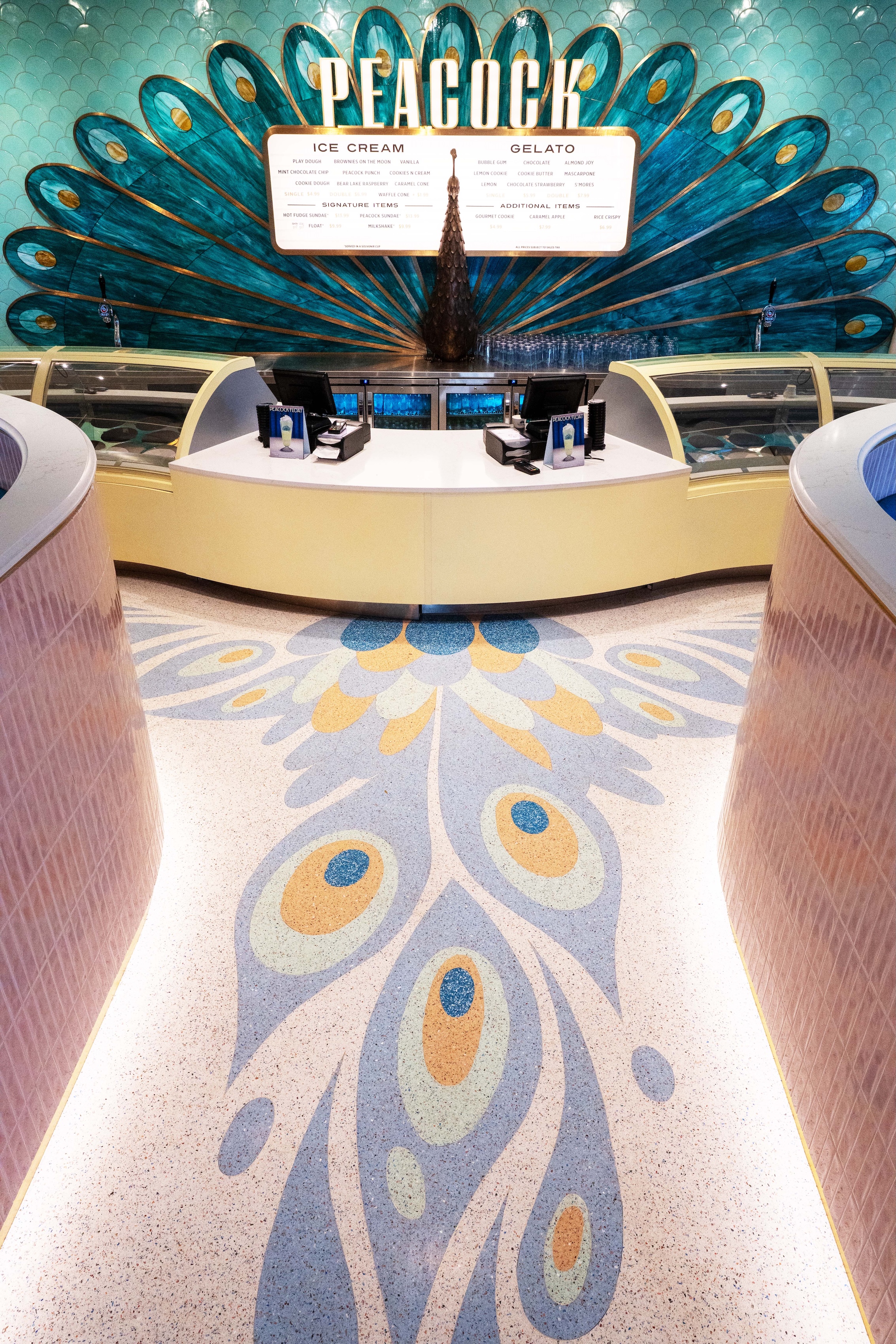
Curving brass divider strips in the Peacock Parlor floor echo the metal peacock forms on the wall behind—a layered motif that designer Greg Walker of WOW Atelier says makes terrazzo “the star of the space.”
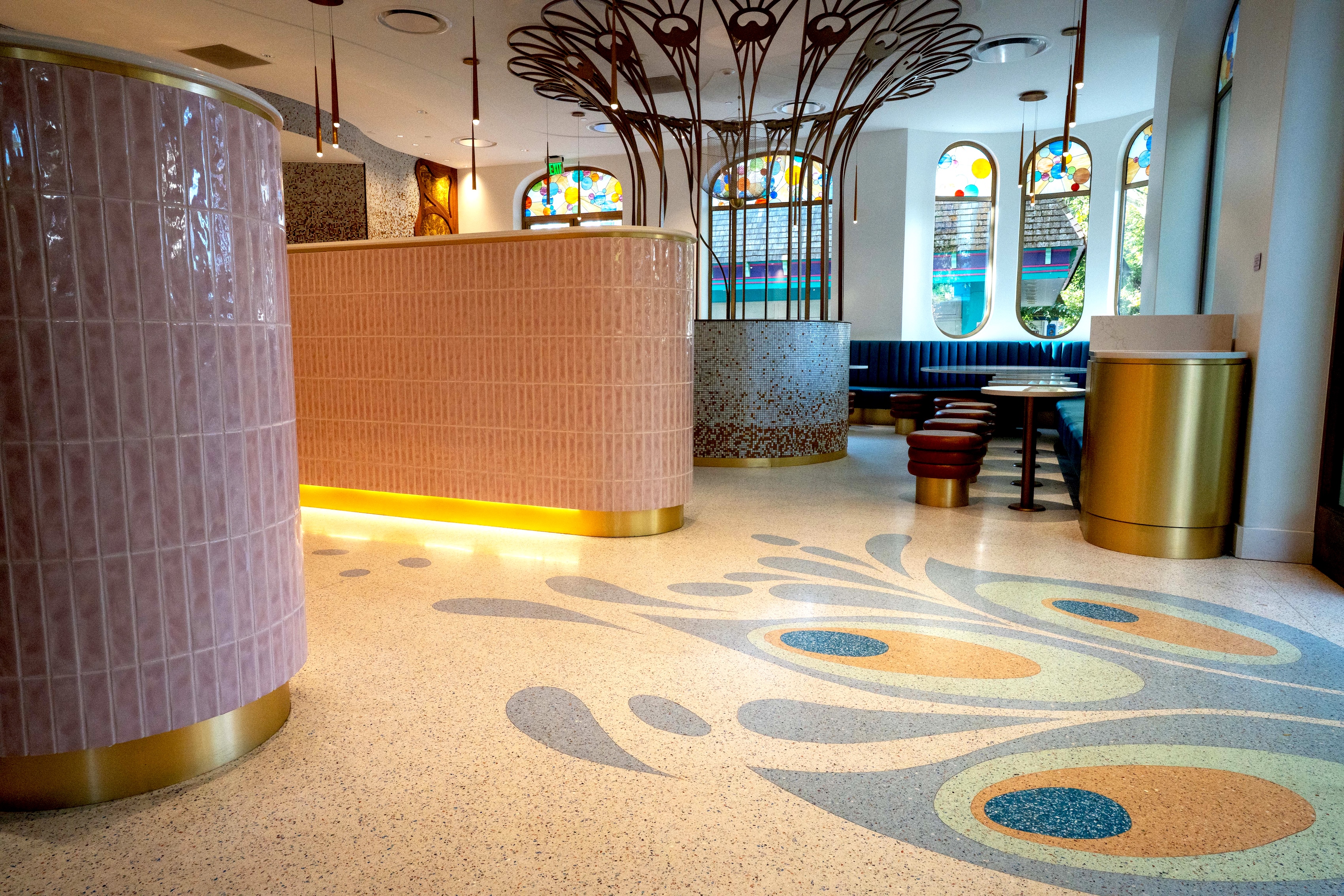
From the curving ice cream cases to the terrazzo feather that leads guests to the counter, Peacock Parlor weaves Art Deco color, brass detailing, and mosaic-inspired geometry into a single immersive interior.
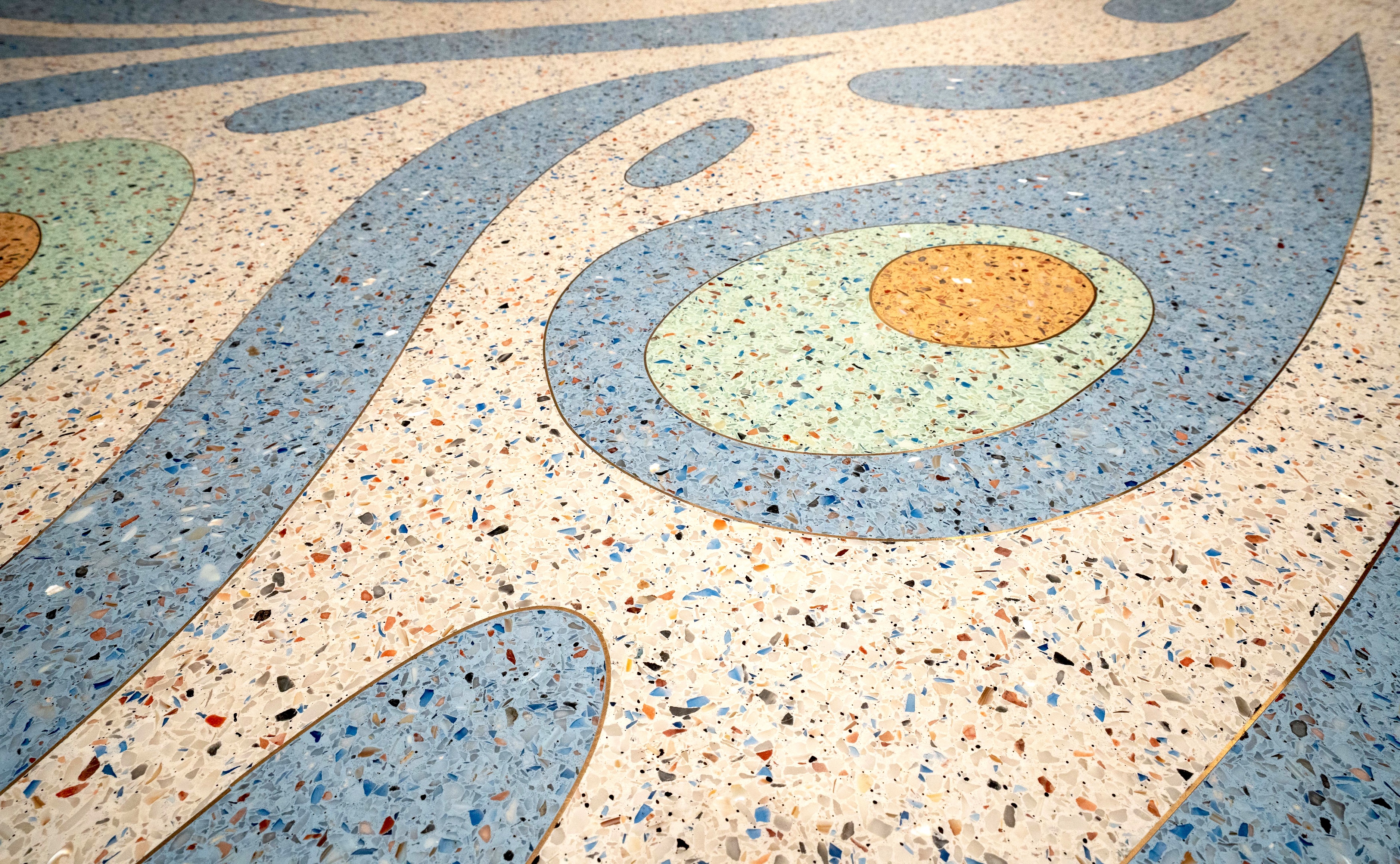
Marble aggregates, glass, mirror chips, and mother-of-pearl are set into a five-color Art Deco palette, creating an iridescent terrazzo surface where hand-bent brass lines trace the contours of a peacock feather.

A handcrafted Art Deco–style terrazzo floor anchors the interior design of Peacock Parlor, the new ice cream shop in the historic Utah park.
The result, Peacock Parlor, has earned FW Specialties of Midvale, Utah, the terrazzo contractor on the project, a 2026 Honor Award from the National Terrazzo & Mosaic Association (NTMA). The award was presented on May 13 at the association’s annual convention.
The design was a collaboration between branding firm Struck and creative studio WOW Atelier, both based in Salt Lake City. Struck developed the concept, and WOW Atelier translated that vision into architectural space and material expression.
From the start, the material choice was never in question. "Immediately, there wasn't another option," said Greg Walker, co-founder of WOW Atelier. "We knew we had to use terrazzo. It's durable, the usage at an amusement park is incredible, and we had to have something beautiful—and we had to have control over the design."
Control was the operative word. The design team reviewed tile systems early on and dismissed them. The palette required precision; small shifts would change how the entire space read. “There are infinite possibilities with terrazzo,” Walker said; it offered what tile could not: the ability to adjust aggregate scale, type, and color with a degree of accuracy that allowed the team to calibrate the design to their exact intent.
That flexibility allowed the team to configure the theme with a large-scale peacock feather rendered in terrazzo at the entry, sized to be legible immediately upon arrival and oriented to guide guests toward the service counter. The theme has literal resonance at Lagoon, where peacocks famously roam the grounds. As Walker noted, the material quickly became “the star of the space.”
The new ice cream parlor’s terrazzo floor incorporates a classic Art Deco palette of five colors combined with marble aggregates, glass, mirror chips, and mother-of-pearl to achieve depth and iridescence. Hand-bent brass divider strips form feather eyespots, tapering quills, and layered curves that precisely intersect. The floor establishes the visual framework for the interior, while coordinated finishes and fixtures reinforce the theme.
Design: Translating Brand into Space
Early in the design process, Struck’s Brent Watt sketched ideas referencing Victorian and Art Deco influences, an atrium-like volume, and curvilinear forms that pointed to the era of the park’s founding. The team examined precedents from late 19th- and early 20th-century architects, including Antoni Gaudí and Victor Horta, who are known for organic geometries, mosaic traditions, and nature-inspired detailing.
Walker said those designers’ use of mosaic patterning and curved lines became an important reference point as the team developed its own language. The peacock emerged as a quintessential element of both Art Nouveau and Art Deco design. Throughout the interior, those influences appear in the curving ice cream cases, canopy, door hardware, booth detailing, and a continuous line that ties ceiling elements to the floor.
“Art Deco has a strong connection with terrazzo and mosaics and patterns in the floor,” Walker said. “So we were always pushing for that to be present in the space.” We refined the concept through ongoing iteration between the branding and architecture teams, improving graphic legibility and the technical feasibility of the materials.
Because terrazzo fabrication fell outside the team's core expertise, NTMA supplier American Specialty Glass became a key technical collaborator early in the design process. Conversations ranged from how specific aggregates would behave in the matrix to color calibration and the tolerances of curved brass strip. "They shared good ideas with us about how to achieve what we were looking for," Walker noted.
“Many factors had to come together in a good way,” he continued. “Everybody had to be at their best, and the design team had to really understand the material.”
Crafting the Feather in Metal and Stones
On this project, the divider material proved as pivotal as the terrazzo itself. “We became obsessed with the thickness of the brass and what angles we could push and how we could turn it,” Walker said. “Different thicknesses have different malleabilities.”
He framed the brass in graphic design terms: stroke weight significantly changes how a composition feels. The brass defined transitions between blues and greens and framed the feather’s geometry. “We were thinking of it as a material transition. Then the material that was not terrazzo became equally critical, almost like positive and negative space. All of a sudden, that negative space matters a lot. It was a function of making the floor, but how you deployed it mattered.”
FW Specialties’ role, with whom WOW Atelier had previously worked on terrazzo projects, was equally decisive. “We could have the greatest ideas in the world,” Walker said, “but if you don’t have the right installation team, it’s all for naught.”
Walker reflected on what terrazzo made possible that no other material could have. “The best part was that the product itself is unique. We’ve all seen terrazzo in airports; there’s an ocean of it, and it has to be durable and easy to clean. And yet it can also be incredibly detailed in a small ice cream shop, where you’re making feather shapes. I don’t know of any other material that has that kind of scale of capacity.”
For the design team, the public response has affirmed the design's success. While designers often invest significant effort in overlooked elements, in this case, the floor is noticed.
“People love it. It’s an important part of the story. You can hear people talking about it—‘Oh my God, look at the floor,’” Walker said. “That happens never.
About the National Terrazzo & Mosaic Association
The annual NTMA Honor Awards recognize outstanding terrazzo installations completed by association member contractors. Entries are evaluated on design achievement, craftsmanship, and technical execution. A full list of this year's 17 Honor Award recipients is available at ntma.com.
Founded in 1923, the NTMA is a nonprofit trade association of over 150 contractor and supplier members, headquartered in Fredericksburg, Texas. The organization establishes national standards for all terrazzo systems and applications, advancing quality craftsmanship and innovation while supporting its members in the trade.
The NTMA provides a broad range of free resources for architects, designers, artists, contractors, maintenance professionals, and property owners. From assisting design teams with specifications to offering technical guidance throughout a project, the NTMA helps ensure terrazzo installations meet the highest standards. The association also offers AIA-registered continuing education programs for architects and design professionals. For more information about terrazzo resources, visit ntma.com. Technical Director Gary French is available at gary@ntma.com.
Terrazzo originated in 15th-century Italy, building on the mosaic traditions of ancient Rome. Venetian marble workers repurposed discarded stone chips into durable, decorative surfaces—a practice that made terrazzo an early sustainable material. Today, terrazzo is still poured by hand on-site, with options for precast panels and waterjet-cut details. Stone, recycled glass, or other aggregates—which may be locally sourced—are set in a cement or epoxy base, and the surface is then polished to reveal the aggregate's color and texture. Valued for its design versatility, ease of maintenance, durability, sustainability, and lifecycle value, terrazzo is built to last the life of a building.
Chad Rakow
National Terrazzo & Mosaic Assocation
+1 800-323-9736
info@ntma.com
Visit us on social media:
LinkedIn
Instagram
Facebook
YouTube
TikTok
National Terrazzo & Mosaic Association 2026 Honor Awards
Legal Disclaimer:
EIN Presswire provides this news content "as is" without warranty of any kind. We do not accept any responsibility or liability for the accuracy, content, images, videos, licenses, completeness, legality, or reliability of the information contained in this article. If you have any complaints or copyright issues related to this article, kindly contact the author above.
